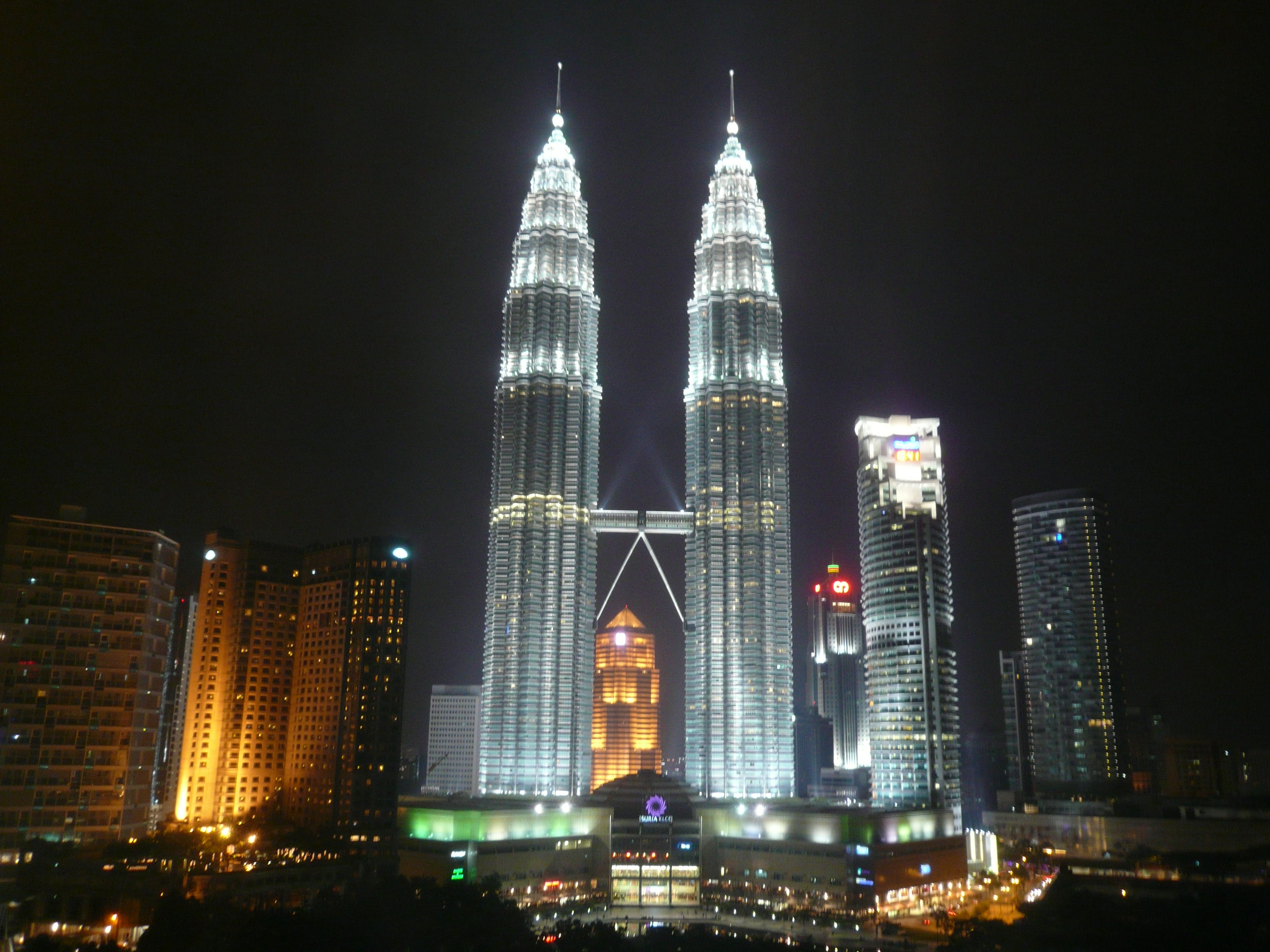
Petronas Towers
The Petronas Twin Towers were the tallest buildings in the world until Taipei 101, as measured to the top of their structural components (spires, but not antennas), took over the record. Spires are considered integral parts of the architectural design of buildings, to which changes would substantially change the appearance and design of the building, whereas antennas may be added or removed without such consequences. The Petronas Twin Towers remain the tallest twin buildings in the world.
The Sears Tower and the World Trade Center towers were each constructed with 110 occupied floors – 22 more than the Petronas Twin Towers’ 88 floors. The Sears Tower and the World Trade Center’s roofs and highest occupied floors substantially exceeded the height of the roof and highest floors of the Petronas Twin Towers. The Sears Tower’s tallest antenna is 75 m (246 ft) taller than the Petronas Twin Towers’ spires. However, in accordance to CTBUH regulations and guidelines, the antennas of the Sears Tower were not counted as part of its architectural features.[3] Therefore, the Petronas Twin Towers exceed the official height of the Sears Tower by 10m, but the Sears Tower has more floors with occupied office space at a higher level.
History
Designed by Argentine-American architect César Pelli, the Petronas Towers were completed in 1998 and became the tallest buildings in the world on the date of completion. They were built on the site of Kuala Lumpur's race track. Because of the depth of the bedrock, the buildings were built on the world's deepest foundations. The 120-meter foundations were built by Bachy Soletanche, and required massive amounts of concrete.
The 88-floor towers are constructed largely of reinforced concrete, with a steel and glass facade designed to resemble motifs found in Islamic art, a reflection of Malaysia's Muslim religion. Another Islamic influence on the design is that the cross-section of the towers is based on a Rub el Hizb (albeit with circular sectors added to meet office space requirements). Due to a lack of steel and the huge cost of importing steel, the towers were constructed on a cheaper radical design of super high-strength reinforced concrete. High-strength concrete is a material familiar to Asian contractors and twice as effective as steel in sway reduction; however, it makes the building twice as heavy on its foundation than a comparable steel building. Supported by 23-by-23 meter concrete cores and an outer ring of widely-spaced super columns, the towers use a sophisticated structural system that accommodates its slender profile and provides from 1300 to 2000 square metres of column-free office space per floor.Below the twin towers is Suria KLCC, a shopping mall, and Dewan Filharmonik Petronas, the home of the Malaysian Philharmonic Orchestra.
Other buildings have used spires to increase their height but have always been taller overall to the pinnacle when trying to claim the title. In the aftermath of the controversy, the rules governing official titles were partially overhauled, and a number of buildings re-classified structural antenna as architectural details to boost their height rating (even though nothing was actually done to the building).
Tenants of the Petronas Twin Towers


Tower One is fully occupied by Petronas and a number of its subsidiaries and associate companies. The office spaces in Tower Two are mostly available for lease to other companies. A number of companies have offices in Tower Two, including Accenture, Al Jazeera English, Carigali Hess Bloomberg, Boeing, IBM, Khazanah Nasional Berhad, McKinsey & Co, TCS, HCL Technologies, Krawler Networks, Microsoft, The Agency (a modeling company) and Reuters.
KLCC Park
Spanning 17 acres (69,000 m2) below the building is the KLCC park with jogging and walking paths, a fountain with incorporated light show, wading pools, and a children's playground. Suria KLCC is one of the largest shopping malls in Malaysia.
